

















Once seen as an act of conquest and geopolitical superiority, manned missions to the Moon are making their comeback as a stepping stone on the path toward the larger goal of interplanetary travel. In March of this year, National Aeronautics and Space Administration (NASA) hopes to launch their brand-new Orion Multi-purpose Crew Vehicle (Orion MPCV) on a 10-day mission around the Moon which they have titled Artemis II.
This mission plans to send a crew of four, including the first woman, first person-of-color, and first non-American NASA astronauts to ever exit low Earth orbit. Not since the 1970s has any person traveled outside of low Earth orbit. Then, the barriers to scientific exploration were high. It is a clear sign of our societal progress that so many firsts may be reached in a single mission.
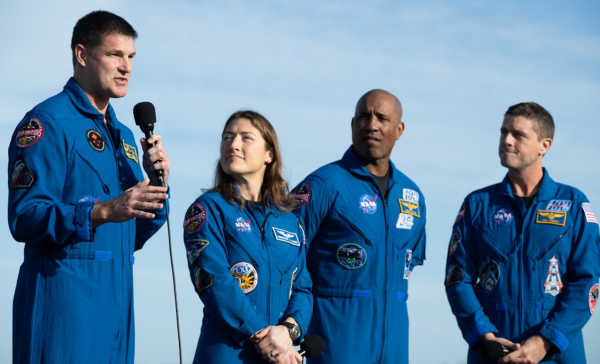
Beyond the obvious cultural advancements this mission marks, it presents a large amount of scientific progress as well. The never-before-used Orion MPCV was designed for missions exactly like that of Artemis II. Designed primarily by aerospace and defense company Lockhead Martin, Orion is built to endure the wares of atmospheric exit and re-entry multiple times, and is capable of lasting 21 days–many beyond the length of this mission–undocked and up to six months docked. Thanks to its self-docking system, longer missions like ones to Mars are made even more achievable.
The launch system used on this mission is also a new one from NASA, only used once before for the unmanned Artemis I test launch. The Space Launch System (SLS) is the only rocket that can launch Orion into space and has three major components; two solid-rocket boosters and a central core. The two solid-rocket boosters are what will launch the spacecraft off the ground, producing the most powerful manned rocket launch in history.
The rocket boosters will separate from the two boosters while still in Earth’s atmosphere and the central core will carry it into low Earth orbit. After an orbit around the planet, Orion will separate from the SLS and its own propulsion system will take the capsule on its way to the far side of the Moon. Most interestingly, the way back home is entirely powered by the Earth’s gravitational pull. This means that the capsule will be returned to Earth no matter what complications there may be with Orion’s propulsion systems during this leg of the mission. Only Orion’s capsule, detached from the launch abort system, will re-enter the atmosphere and touch back down on Earth.
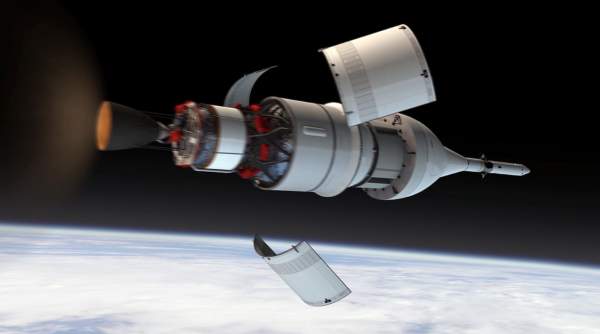
Now the question may arise as to how this mission is preparatory for a manned mission to Mars? The overarching focus of space exploration has been Mars for the past few decades. The planet’s potential for either active or remnant biology has peaked humanity’s interest. With the help of missions like Artemis II, we are closer than ever to a first-hand look at the red planet.
In order to get anywhere near achieving this goal, many technological advances must be made. The advancement that the Artemis II mission plans to reach is long distance space travel. A mission of this distance has been achieved before, but not in over half a century. The Artemis II mission holds promise of consistent and lengthy manned space missions, not just to the moon but other celestial objects as well.